

Tracklist:
Matador
Eisengrau
Sickle Moon
If Only
Feuerwerk (31·Dez)
Illusion (Version)
Morning (Will There Really Be)
Manchmal
Polarlicht
Ozean
Dogma I
4
Matador × Official Video
This content can't be displayed because you have declined the use of cookies necessary for its display. You can learn more about how cookies are used on this site and adjust your preferences in detail in the settings.
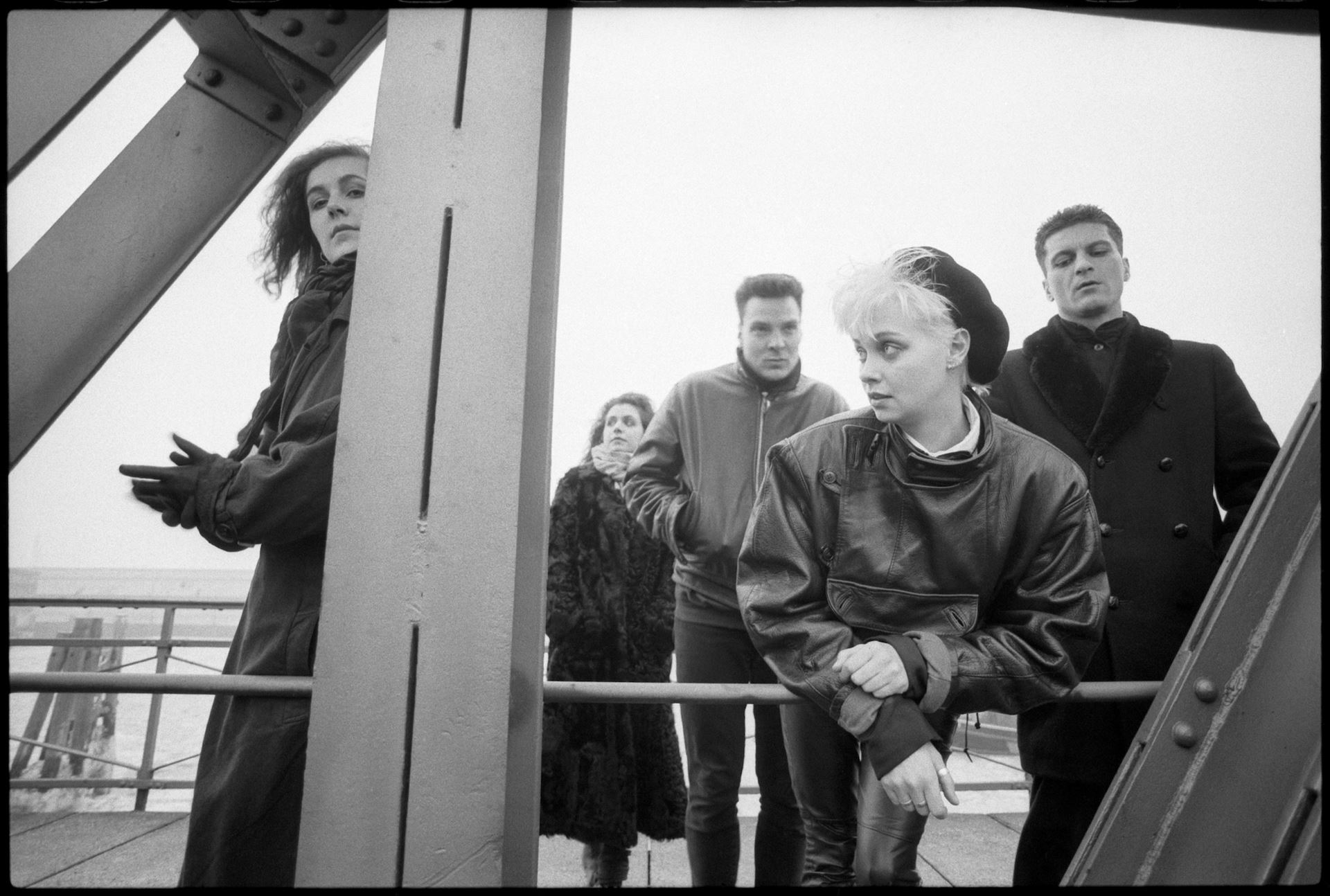
Photo: Kevin Cummings
By early 1987, the British majors were busy polishing up goth and post-punk for chart duty, pushing bands with big choruses and even bigger hair into the Top 40. In the middle of that, a Hamburg group who still preferred to sing largely in German came back with a record that was darker, sharper and somehow more self-possessed than much of what surrounded it. Viva arrived not on 4AD, who had issued Xmal’s first two albums, but on their own X-ile imprint via Phonogram, a move that said as much about control and stubbornness as it did about ambition.
Viva was the payoff for a turbulent few years. After the stark rush of Fetisch (1983) and the more expansive Tocsin (1984), Xmal had grown wary of label expectations. In a later interview, Anja Huwe recalled how 4AD’s Ivo Watts-Russell had floated the idea that they should become “the new Wire”, and how the band resisted being steered away from the songs they actually wanted to write. They split with 4AD, toured hard with the likes of The Mission and The Cult, and watched from the sidelines as British guitar bands with a broadly similar audience were pushed into the charts. Viva was the moment they tried to do things on their own terms, with major-label distribution but no one telling them which language to sing in.
Recorded at Brunwey Studios in Hamburg across 1985 and 1986, Viva runs just under fifty minutes and folds alternative rock, goth and dark wave into something leaner than the lumbering tag “gothic rock” suggests. The line-up by this point was settled: Anja on vocals, Manuela Rickers on guitar, Fiona Sangster on keyboards, Wolfgang Ellerbrock on bass and Peter Bellendir on drums. The production team was unusually star-studded for a band who had come out of Hamburg’s DIY punk scene. Matador was produced by Hugh Cornwell, fresh from his work with The Stranglers, while the bulk of the album was handled by Mick Glossop (Magazine, Public Image Ltd) with engineer/mixer Gavin MacKillop, plus Barry Hammond on additional engineering. Artwork and photography came from Anton Corbijn and Nigel Grierson, keeping a visual thread to the 4AD years even as the music moved elsewhere.
Everything on Viva seems to pivot around Matador. First issued in the UK in 1986 as a standalone single, it acted as a calling card for this new phase: a four-minute surge driven by Rickers’ clipped guitar figure, Bellendir’s martial tom patterns and a bassline that keeps trying to drag the song into outright rock-anthem territory. Anja chants and howls her way through the verses in German before the title – one of several nods to the band’s fascination with Spanish words and imagery – lands like a slogan. The limited 12-inch came with a booklet featuring some of Anja’s early artwork, hinting at the visual path she would later pursue full-time.
On the UK LP, Matador is followed by Eisengrau and Sickle Moon, a trio that sets out the record’s balance between toughness and a more aerodynamic sense of melody. Eisengrau snaps and swirls around a simple descending figure, all spidery keys and tightly gated drums, while Sickle Moon lets a little more air into the arrangement without softening the attack. By the time If Only arrives, you can hear why some later listeners have heard faint echoes of Cocteau Twins in the way the guitar and keyboards curl around each other, even though the rhythm section keeps everything firmly earthbound.
The album’s centrepiece is Feuerwerk (31 Dez), a six-minute slow burn that feels like walking through a city at closing time on New Year’s Eve: stray explosions in the distance, scraps of melody carried on the wind, drums that seem to lag a fraction behind the beat and then snap back into focus. Where earlier Xmal tracks could sometimes tip into outright chaos, here the band sound drilled and deliberate; one later review described Viva as “highly polished and amazingly precise” and the group as a “well-oiled machine”, particularly on songs like If Only, Illusion and Feuerwerk (31 Dez). That sense of control doesn’t blunt Anja’s delivery – if anything it throws her phrasing into sharper relief.
Viva’s most striking left-turn is Morning (Will There Really Be), which sets an Emily Dickinson poem to music. Rather than treating the text as delicate literature, the band wrap it in chiming guitar, synth washes and a rhythm that rises and falls in waves across six minutes. Anja’s voice sits somewhere between recitation and incantation, refusing to tidy Dickinson’s language into neat hook lines. It is one of the clearest signs of how far Xmal had travelled from their early, punch-drunk singles: they were still dealing in atmosphere and confrontation, but they were now confident enough to stretch time and leave open space in the arrangements.
Language has always been one of Xmal Deutschland’s more under-discussed strengths, and Viva pushes that further. Across the record they switch between German, English and snatches of Spanish, a polyglot approach that some writers later singled out as part of their most personal artistic stamp. Tracks such as Manchmal and Eisengrau remain firmly rooted in German, but Dogma I and Morning (Will There Really Be) bring English phrases to the fore, while Matador keeps its Spanish title. It’s less a gimmick than a reflection of how the band were moving on from the early-80s Hamburg underground into a world of international touring, Peel Sessions and British and Canadian distribution deals.
The closing run – Manchmal, Polarlicht, Ozean, Dogma I – is where Viva quietly underlines its depth. Manchmal is almost pop in its stately, ascending chorus, all the more effective for the way Anja undercuts it with clipped, uneasy verses. Polarlicht is three minutes of icy shimmer that, decades later, would be folded into Anja’s solo track Living in the Forest for the 2024 mash-up single PolarForest, literally stitching 1987 Xmal into her new work. Ozean and Dogma I feel like mirror images – one surging forward, one more locked-down – and together they give the album an ending that’s unsettled rather than resolved.
Collectors still argue over the “correct” version of Viva. The original UK vinyl, issued on X-ile/Phonogram as XMALP1, runs to ten tracks, from Matador through to Dogma I. CD editions add Illusion (Version) and the short, pulsing 4, bringing the running time close to fifty minutes. For years the album was notoriously hard to find in the United States; despite decent sales in Canada and England, Viva became a very hard-to-find record in the US market, with CD copies changing hands for high prices on auction sites. That relative scarcity has probably helped fix it in fans’ minds as a cult object rather than just “the one after Tocsin”.
Critical response at the time was muted compared to the attention lavished on some of Xmal’s peers, but the album has aged well. Trouser Press, writing about the band’s catalogue as a whole, described the Hamburg quintet’s sound as dense and heavy, with Anja’s vocals pushed into the foreground. Later appraisals have been kinder: online reviews talk about Viva as gripping and gloomy yet unexpectedly tuneful, and fan-curated ranking sites now tend to place it just behind Fetisch in the band’s discography. Among listeners – particularly those who came to Xmal via reissues rather than the original 4AD LPs – there’s a strong argument that Viva is the most complete statement of what the band could do once they had bigger studios and more time.
What happened next is part of why Viva feels like such a fulcrum. Xmal followed it with Devils in 1989, released through Metronome Musik and sung entirely in English, a decision Anja later said was made simply to “give it a go” after years of being told to switch languages. Distribution woes persisted: Devils was licensed outside Germany only to Attic in Canada, never gaining a proper British release, and by the early 1990s the band had quietly split. Anja stepped away from music altogether, building a new career as a visual artist, while the records – Fetisch, Tocsin, Viva and Devils – slipped in and out of print, carried forward by fanzines, DJs and the occasional goth reissue programme.
In the 2020s that story has been rewritten. Anja’s solo album Codes, released on Sacred Bones Records in March 2024, brought her back into studios and onto stages, with former Xmal guitarist Manuela Rickers again involved. At the same time 4AD-era material has been gathered into the box set Gift: The 4AD Years, and early singles and Peel sessions have been dusted off for new audiences. When she played the Grauzone Festival and other European dates, those shows folded Xmal songs back into the present. The fact that Polarlicht could be reworked into PolarForest nearly four decades on says a lot about Viva’s afterlife: a record that once felt hard to track down now feeds directly into the work of an artist who never really left it behind.
Text: decAde7787.com